
Tree & shrub disease treatment
Most of what infects a tree arrives in a cool, wet spring with symptoms not showing until July. By then, the spray that would have prevented it is months behind you.
 ISA Certified Arborists
20,000+ customers since 1985
Free on-site inspection, usually within 3-5 business days · Diagnosis and price in writing · Safe to walk on once dry
Sick trees their owners had already written off.
“Great service! Restored health to a sick tree I thought for sure was a goner.”
Nathan Brock
“Thank you for saving my very old trees (black locust and horse chestnut), which have never looked so good in the thirty years I’ve lived with them.”
Sid Harper
Spring decides the year, even though you see it in July
Fungal problems go for leaves, needles, blossoms and twigs. Left alone, several of them get progressively worse and can eventually kill the tree or shrub.
The single biggest risk factor is proximity: an infected plant nearby is how most of these arrive. Weather does the rest. Cool, wet springs are ideal for infection, and a stressed plant has less to defend itself with.
Here’s the part that causes the confusion. In our area most of these spread in spring even though the symptoms often don’t show until much later in the year. You see it in July and want it sprayed in July, and by then we’re mostly protecting next year’s leaves. That’s not a reason to wait. It’s a reason to get on the calendar.
The leaf tells you which disease you have
The symptoms are more specific than they look. Most of the time the plant tells you which one you have, if you know what the pattern means.
- Black spots on aspen leaves: leaf spot fungus
- Brown-black spots on leaves and fruit: scab
- Distorted, dead leaf tissue: anthracnose
- Neat circular holes: coryneum blight
- White growth that wipes off the surface: powdery mildew
- Spotted or banded needle tips: tip blight
- Lower spruce branches browning, with white resin on the bark: cytospora canker
- Leaves wilting and browning on one branch or one side of the tree: verticillium wilt
- Scorched shoots with a hooked tip: fireblight

Verticillium wilt: one branch browning at a time
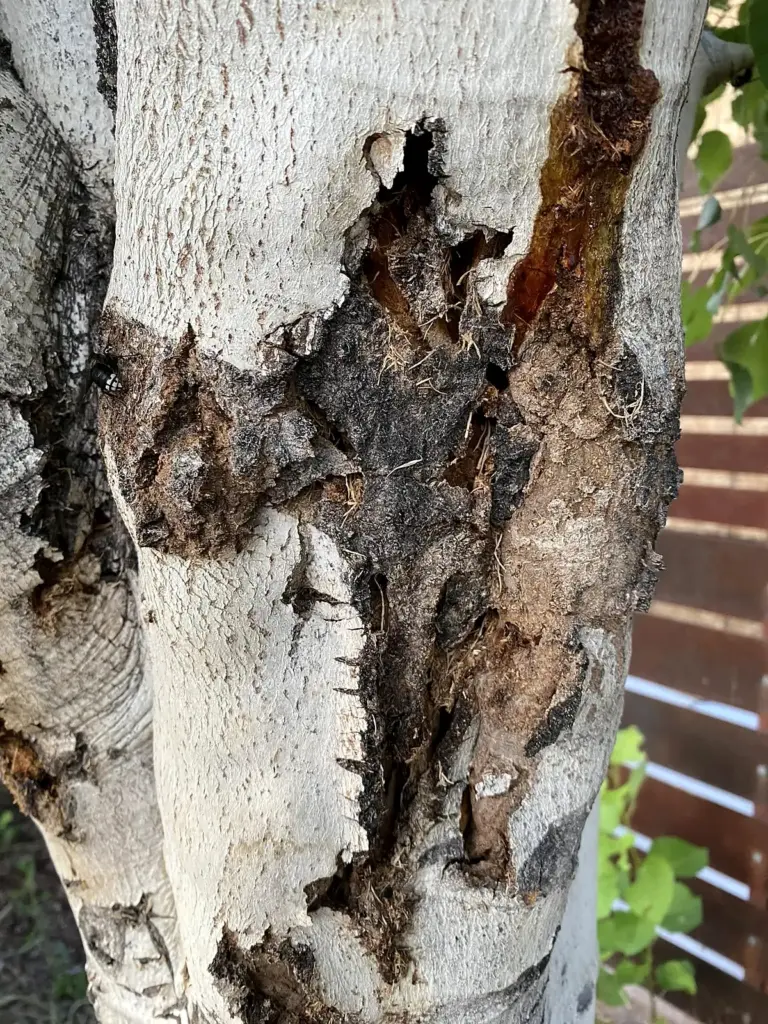
Canker: cracked, blackened bark on a trunk
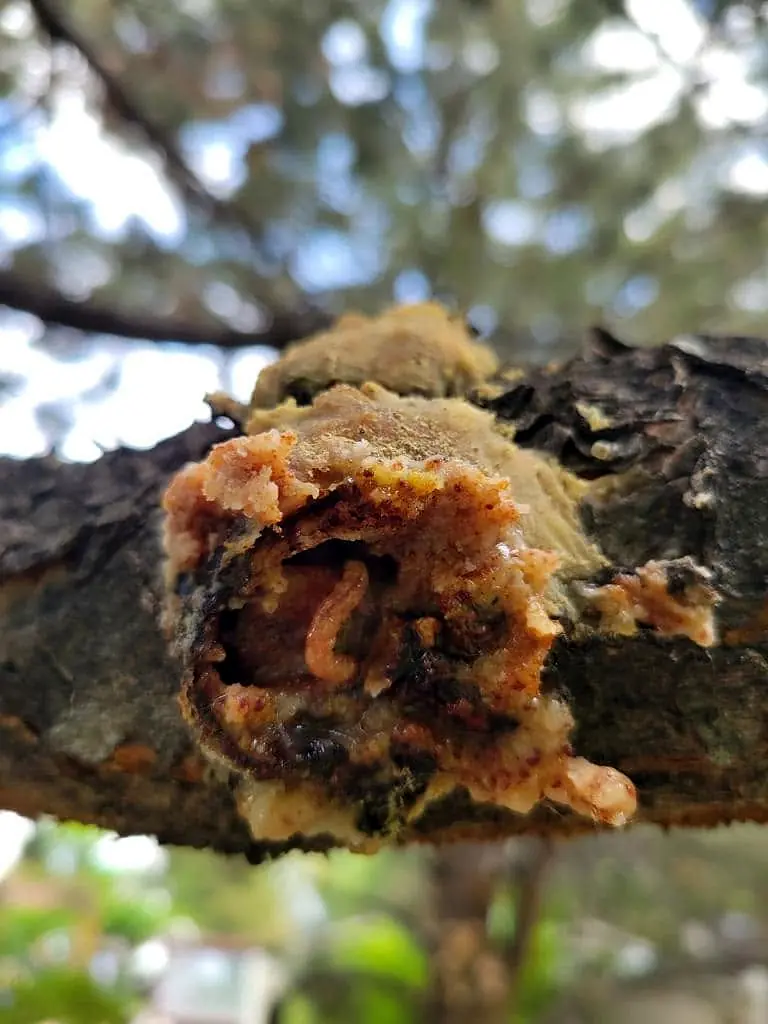
Decay inside a branch union

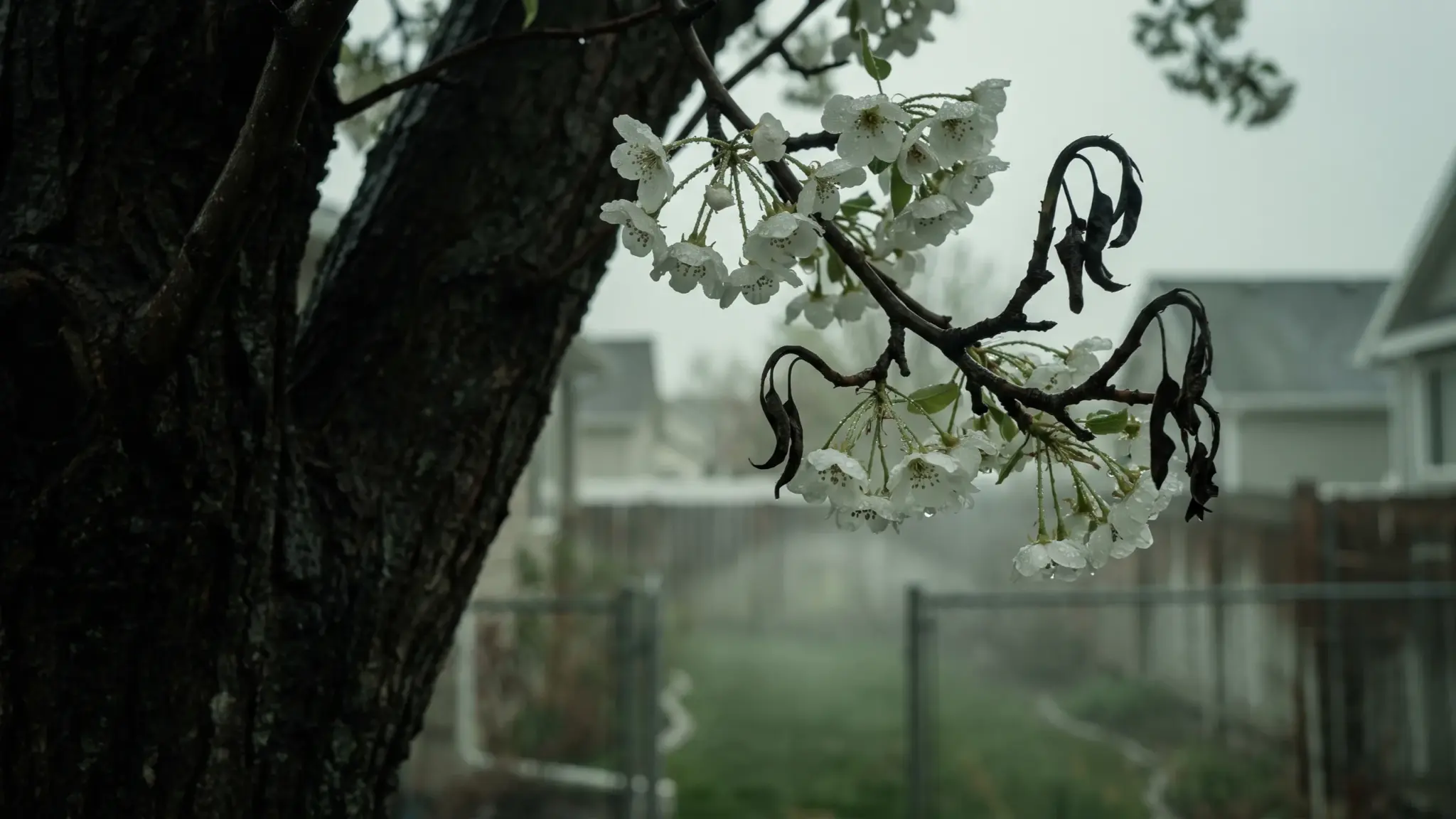
Fireblight: the dying shoot tip curls into a shepherd’s crook
Fireblight is a different animal
Fireblight is bacterial rather than fungal, which changes everything about how it’s handled. It’s caused by Erwinia amylovora, and it earns its name: infected shoots look scorched, and the tip of a dying shoot curls over into a hook that arborists call a shepherd’s crook.
It infects through the blossoms, which is why warm rainy weather during bloom is the dangerous combination, and it travels on rain, dew, insects and dirty pruning tools. It matters most on flowering pear, apple and crabapple, mountain ash, hawthorn and pyracantha.
Prune it out well below the visible damage, sanitize between cuts, and get the timing right at bloom. There’s no cure once it’s in.
Cytospora on blue spruce climbs a few branches a year
Cytospora canker and tip blight are the two we’re called out for most on evergreens, and both get mistaken for drought.
Tip blight shows as spotted or banded tips on pines, working from the new growth back. Cytospora canker works on spruce from the bottom up: a lower branch browns and drops its needles, and the bark on it shows patches of white resin, which is the tell. It climbs a few branches a year, which is why an affected spruce looks bare through the bottom while the top still looks fine.
Colorado blue spruce is the one we see it on most, and a mature blue spruce is often the biggest living thing in the yard. That’s the one worth catching early. No spray cures cytospora. It goes after a stressed tree, so the program is about the stress: deep watering, mulch over the root zone, feeding the roots, and pruning out infected branches in dry weather with sanitized tools. Tip blight on pine is a fungicide program timed to new growth over more than one season, not a single visit. We’d rather tell you that up front than surprise you with it in year two.
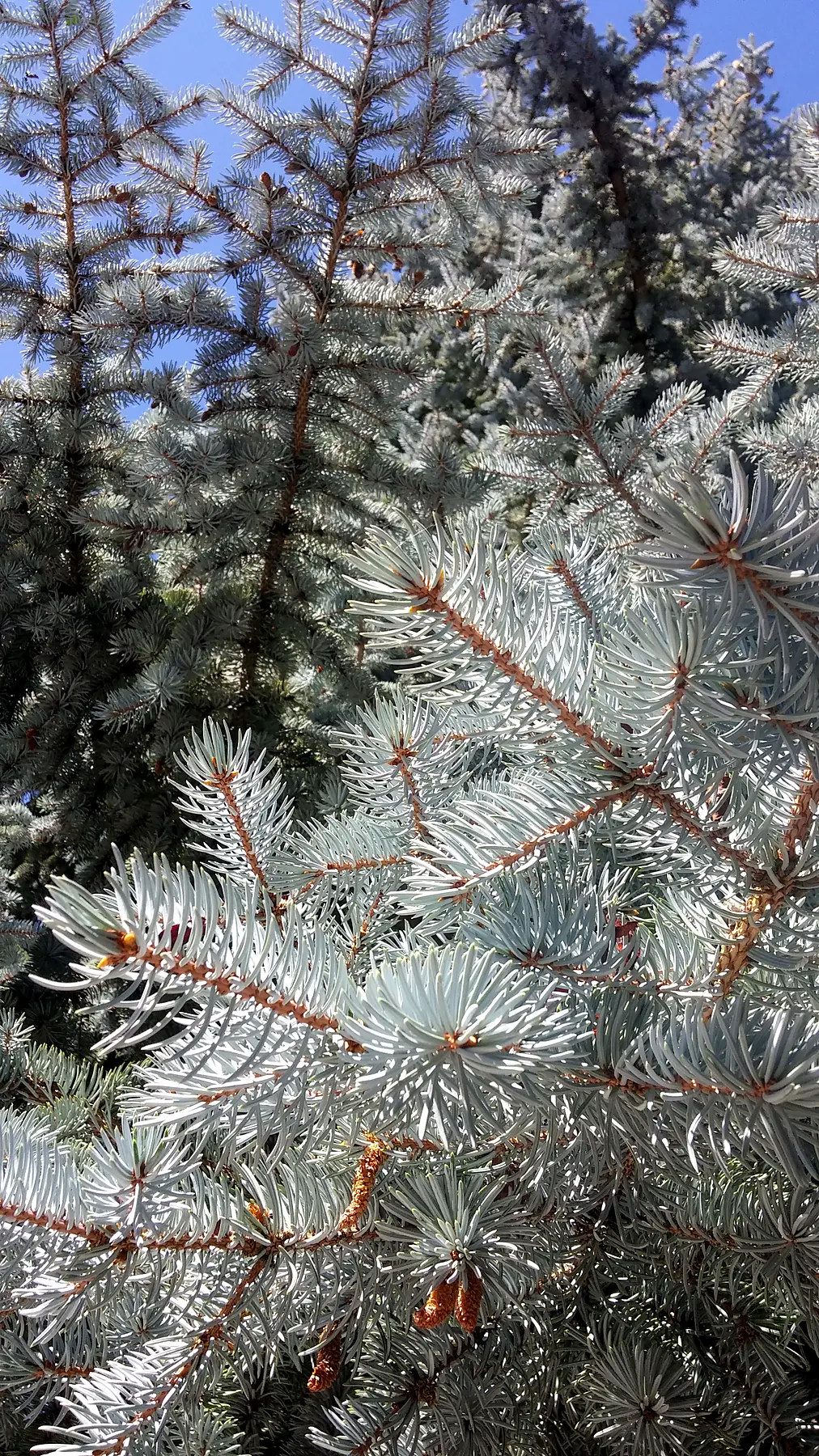
A blue spruce goes bare from the bottom up, a few branches a year.
No spray cures cytospora, so the sooner we take the stress off the tree, the more of it you keep. The inspection and the written plan are free.
The nine we treat most in Utah, and what they go for
- Leaf spot fungus: aspens, ornamental plums (trees and shrubs)
- Scab fungus: apple trees, crabapple trees, and pear trees
- Anthracnose: sycamores, London planes, maples, and native scrub oak
- Coryneum blight: apricot, peach, nectarine, cherry and flowering cherry trees
- Powdery mildew: apple trees, crabapple trees, and euonymus
- Tip blight fungus: pines
- Cytospora canker: Colorado blue spruce and other spruces
- Verticillium wilt: maples, ash, catalpa and redbud
- Fireblight: flowering pear trees, crabapple trees, mountain ash, pyracantha, and roses
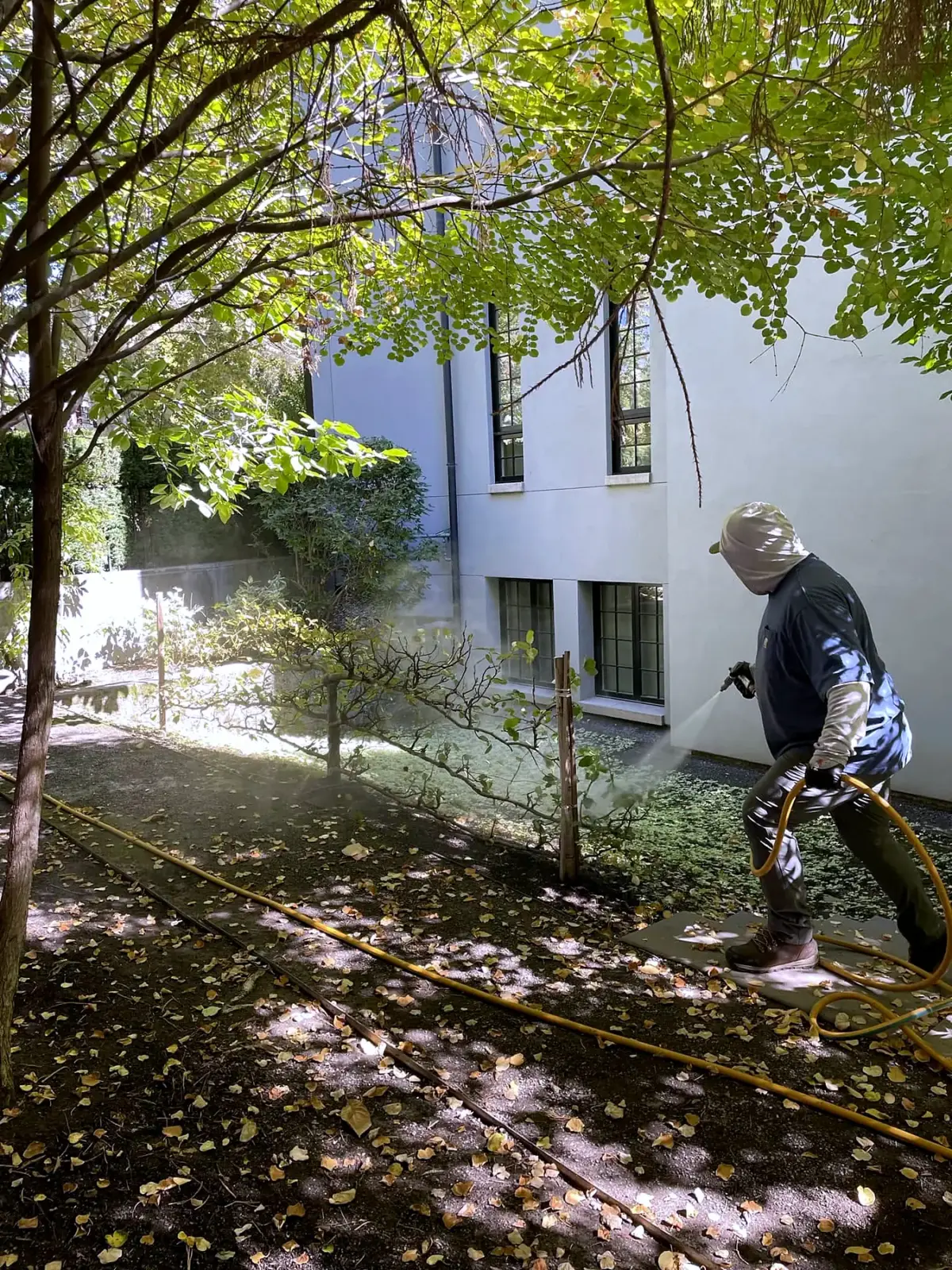
Sprayed preventatively in spring, timed to the disease
Most of these can be sprayed preventatively in spring, and the timing is set by the disease rather than by the calendar on the wall.
- Preventative spring fungicide, timed to bud break or bloom
- A second round in late summer and early fall for powdery mildew
- Pruning it out, sanitizing between cuts, which is the whole answer for fireblight
- Bark banding, where drift onto a garden or a neighbor’s property is the concern
- Taking the stress off the tree for cytospora canker and verticillium wilt, which no spray cures: deep watering, mulch and root zone fertilizing
What a fungicide protects is the growth that hasn’t happened yet
There’s no cure for fireblight once it’s in the tissue. There’s no spray that undoes last year’s damage: a leaf that’s been scarred stays scarred until it falls. And anything already dead comes out; a fungicide won’t bring it back.
What a program does is protect the growth that hasn’t happened yet. That’s a real result, and it’s worth being clear that it’s the result you’re buying.
Four steps, and the spray lands in the window that decides the year.
1
Free inspection
A certified arborist walks the property and works out what’s actually wrong. No charge, and no obligation.
2
It goes in writing
You get the diagnosis and the price before anything is treated, so there are no surprises on the invoice.
3
Treated in its season
We come back in the window that works on your tree, which is rarely the week you happened to call.
4
We check it
We look at how the tree responded and tell you what it needs next year, or that it needs nothing.
The questions we get asked before we start.
I’m only seeing it now, in July. Is it too late?
For this year’s leaves, usually yes. Most of these infect in a cool, wet spring and show months later. That’s not a reason to wait, though: it’s the reason to get on next spring’s calendar now.
Can cytospora canker be cured?
No spray cures it. What works is taking the stress off the tree: deep watering, mulch over the root zone, feeding the roots, and pruning out infected branches in dry weather with sanitized tools.
What about fireblight?
There’s no cure once it’s in the tissue. It gets pruned out well below the visible damage with sanitizing between cuts, and the real work is timing the bloom window the following year.
Will one visit fix it?
Sometimes. Tip blight on pine is a fungicide program timed to new growth over more than one season, and we’d rather tell you that up front than surprise you with it in year two.


Get your trees on the spring spray calendar.
A certified arborist will come to your property, diagnose what’s wrong, and write up an estimate. Serving Salt Lake County, Davis County, Utah County and Park City.
- Free on-site inspection and a written estimate. No obligation.
- We’re usually out within 3-5 business days.
- ISA Certified Arborists. Licensed and insured pesticide applicators.
- Family-run in Salt Lake City since 1985.
- If your tree doesn’t need treatment, we’ll tell you that.
- Someone answers the phone, Monday to Friday, 8:00 am to 5:00 pm.